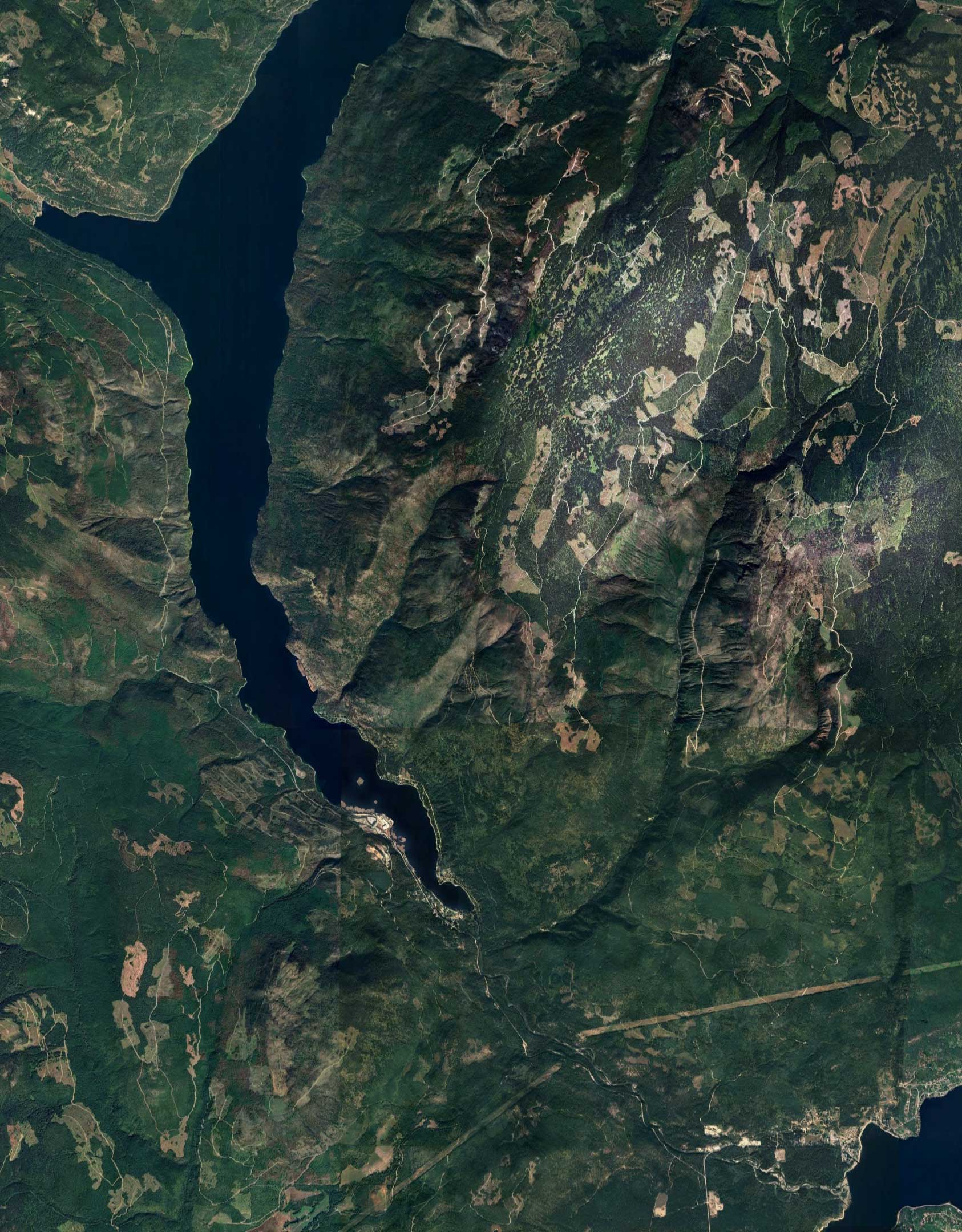
Lamont Ridge
The Lamont Ridge Project is located approximately 200 kilometres east of Vancouver and west to southwest of Princeton, British Columbia in the Similkameen Mining Division. The Property consists of seven contiguous mineral claims with a total area of approximately 7,086 hectares (17,510 acres).
The Site
The Site
The Site
Geological Setting
The Lamont Ridge Project (the “Project”) is located approximately 200 kilometres east of Vancouver and west to southwest of Princeton, British Columbia in the Similkameen Mining Division.
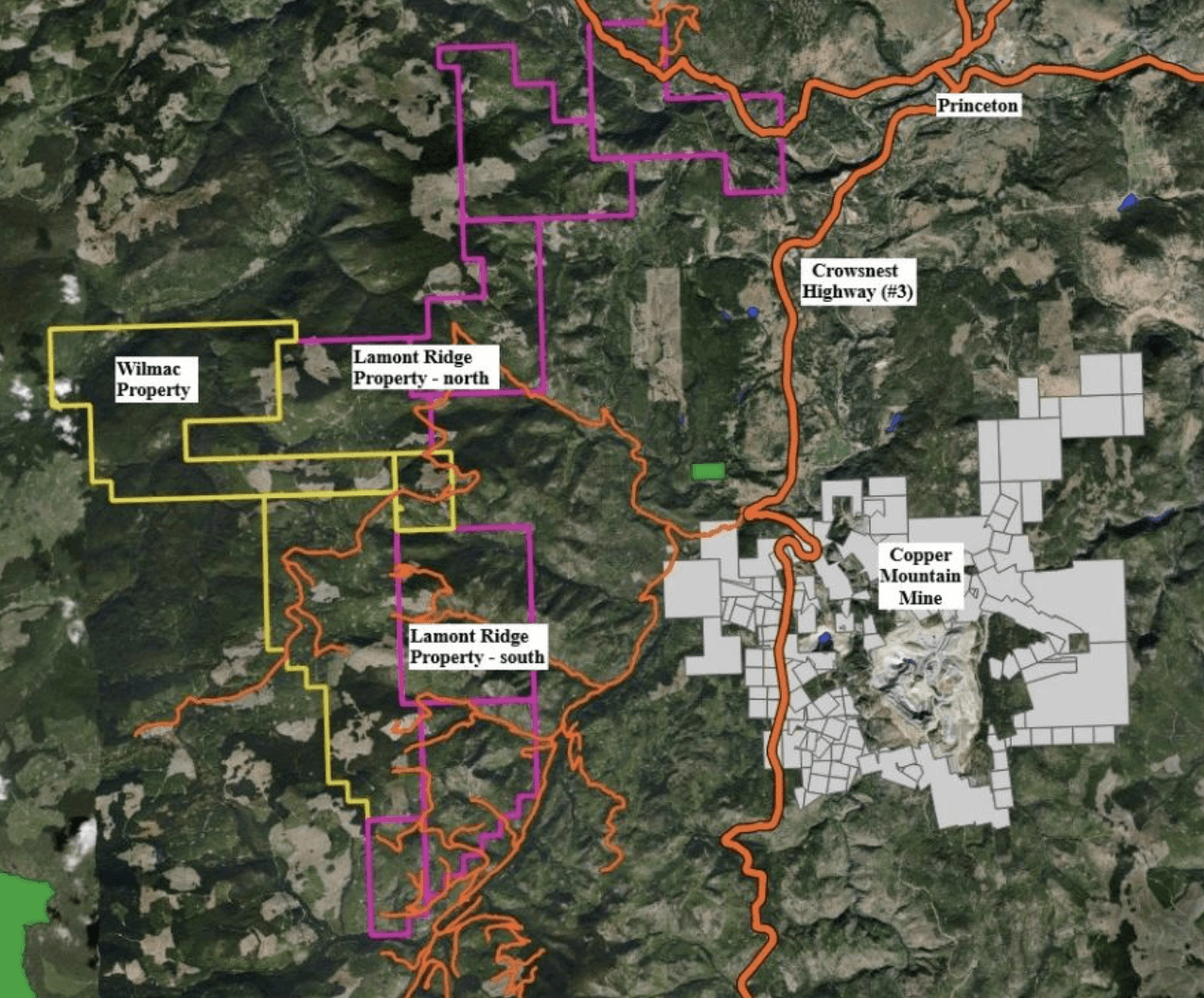
Property Location Map
Property Location Map
Site Potential
Site Potential
Site Potential
Mineralization Types Identified
Soil sampling and 3D IP/AMT geophysics at Lamont Ridge reveal broad copper anomalies coincident with chargeability and conductivity features tied to two parent intrusive bodies. These results collectively suggest a well-developed porphyry environment with multiple vectors toward potential mineralized centers.
Sericite, chlorite and epidote as selective replacement and/or veins
exponential increase in usage
(1900–2020)
Large and extensive Iron carbonate – silica alteration haloes
Projected annual copper demand
Rumble Resources Potential
Rumble Resources Potential
Rumble Resources Potential
Exploration has confirmed multiple locations having copper porphyry-style alteration and/or mineralizations, highlighting the property’s strong geological potential
Strong Cu anomalies up to 1.67% at surface
Road-accessible property → low infrastructure barrier
Continue geochemical sampling (soil and rock), expand trenching & IP/AMT geophysical coverage → develop / define drill targets
Continue geochemical sampling (soil and rock), expand trenching & IP/AMT geophysical coverage → develop / define drill targets
In 2024, soil sampling on the Lamont Grid returned a number of anomalous samples and, together with a small number of anomalous rock samples, led to an Induced Potential / Audio Frequency Magnetotelluric geophysical survey
Results are interpreted to document two parent intrusive bodies. One is characterized by high Resistivity, on the west half of the grid. On the east half of the grid, the survey returned a high Chargeability anomaly underlain by a high conductivity anomaly, comprising a compelling drill target. A second NoW permit application has been submitted for Lamont Ridge and includes proposed locations for 8 drill pads.
Intrusive exposures mapped on the Lamont Ridge Property are similarly interpreted to represent the uppermost portions of the interpreted intrusive complex west of the Boundary Fault
In 2024, soil sampling on the Lamont Grid returned a number of anomalous samples and, together with a small number of anomalous rock samples, led to an Induced Potential / Audio Frequency Magnetotelluric geophysical survey
Results are interpreted to document two parent intrusive bodies. One is characterized by high Resistivity, on the west half of the grid. On the east half of the grid, the survey returned a high Chargeability anomaly underlain by a high conductivity anomaly, comprising a compelling drill target. A second NoW permit application has been submitted for Lamont Ridge and includes proposed locations for 8 drill pads.
Intrusive exposures mapped on the Lamont Ridge Property are similarly interpreted to represent the uppermost portions of the interpreted intrusive complex west of the Boundary Fault
In 2024, soil sampling on the Lamont Grid returned a number of anomalous samples and, together with a small number of anomalous rock samples, led to an Induced Potential / Audio Frequency Magnetotelluric geophysical survey
Results are interpreted to document two parent intrusive bodies. One is characterized by high Resistivity, on the west half of the grid. On the east half of the grid, the survey returned a high Chargeability anomaly underlain by a high conductivity anomaly, comprising a compelling drill target. A second NoW permit application has been submitted for Lamont Ridge and includes proposed locations for 8 drill pads.
Intrusive exposures mapped on the Lamont Ridge Property are similarly interpreted to represent the uppermost portions of the interpreted intrusive complex west of the Boundary Fault
In 2024, soil sampling on the Lamont Grid returned a number of anomalous samples and, together with a small number of anomalous rock samples, led to an Induced Potential / Audio Frequency Magnetotelluric geophysical survey
Results are interpreted to document two parent intrusive bodies. One is characterized by high Resistivity, on the west half of the grid. On the east half of the grid, the survey returned a high Chargeability anomaly underlain by a high conductivity anomaly, comprising a compelling drill target. A second NoW permit application has been submitted for Lamont Ridge and includes proposed locations for 8 drill pads.
Intrusive exposures mapped on the Lamont Ridge Property are similarly interpreted to represent the uppermost portions of the interpreted intrusive complex west of the Boundary Fault
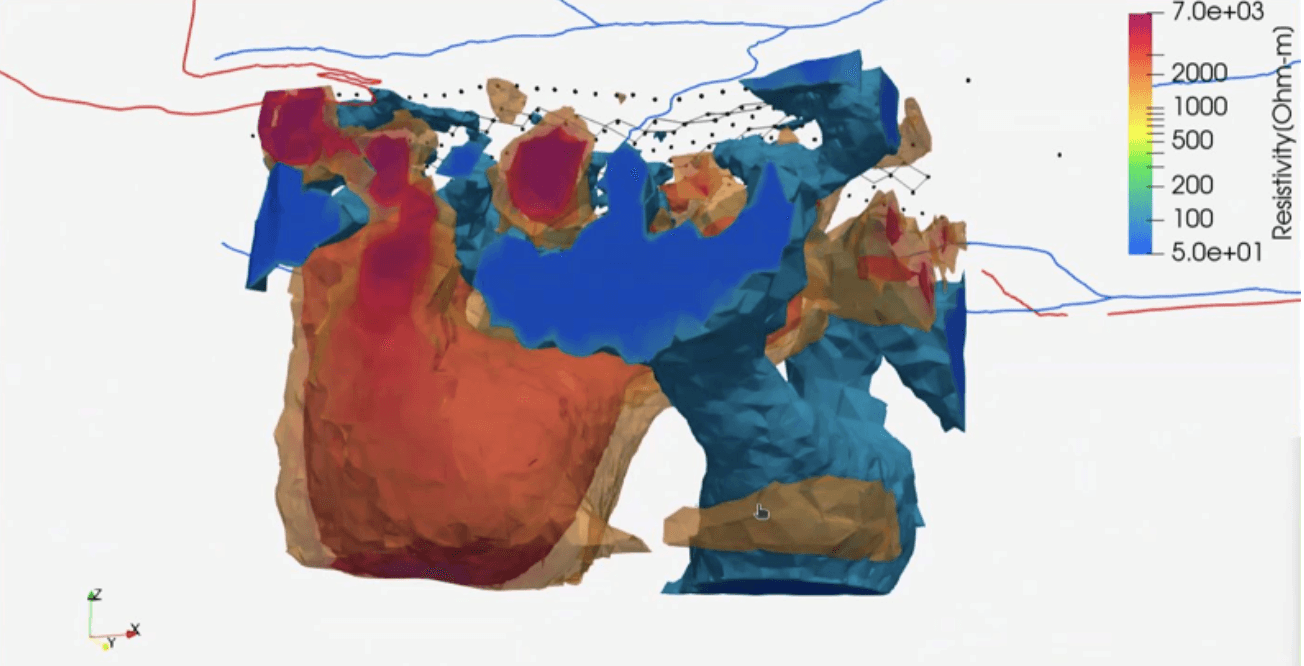
Resistivity high in AMT data to left (west) and pipe-like resistivity low to right (east). Multiple pipe-like resistivity lows evident which merge at depth into the interpreted parent intrusives. Display shows the 100, 1,500, 4,000 and 10,000 ohm meter AMT Resistivity thresholds. Vertical section, view to north
Resistivity high in AMT data to left (west) and pipe-like resistivity low to right (east). Multiple pipe-like resistivity lows evident which merge at depth into the interpreted parent intrusives. Display shows the 100, 1,500, 4,000 and 10,000 ohm meter AMT Resistivity thresholds. Vertical section, view to north
Resistivity high in AMT data to left (west) and pipe-like resistivity low to right (east). Multiple pipe-like resistivity lows evident which merge at depth into the interpreted parent intrusives. Display shows the 100, 1,500, 4,000 and 10,000 ohm meter AMT Resistivity thresholds. Vertical section, view to north
Resistivity high in AMT data to left (west) and pipe-like resistivity low to right (east). Multiple pipe-like resistivity lows evident which merge at depth into the interpreted parent intrusives. Display shows the 100, 1,500, 4,000 and 10,000 ohm meter AMT Resistivity thresholds. Vertical section, view to north
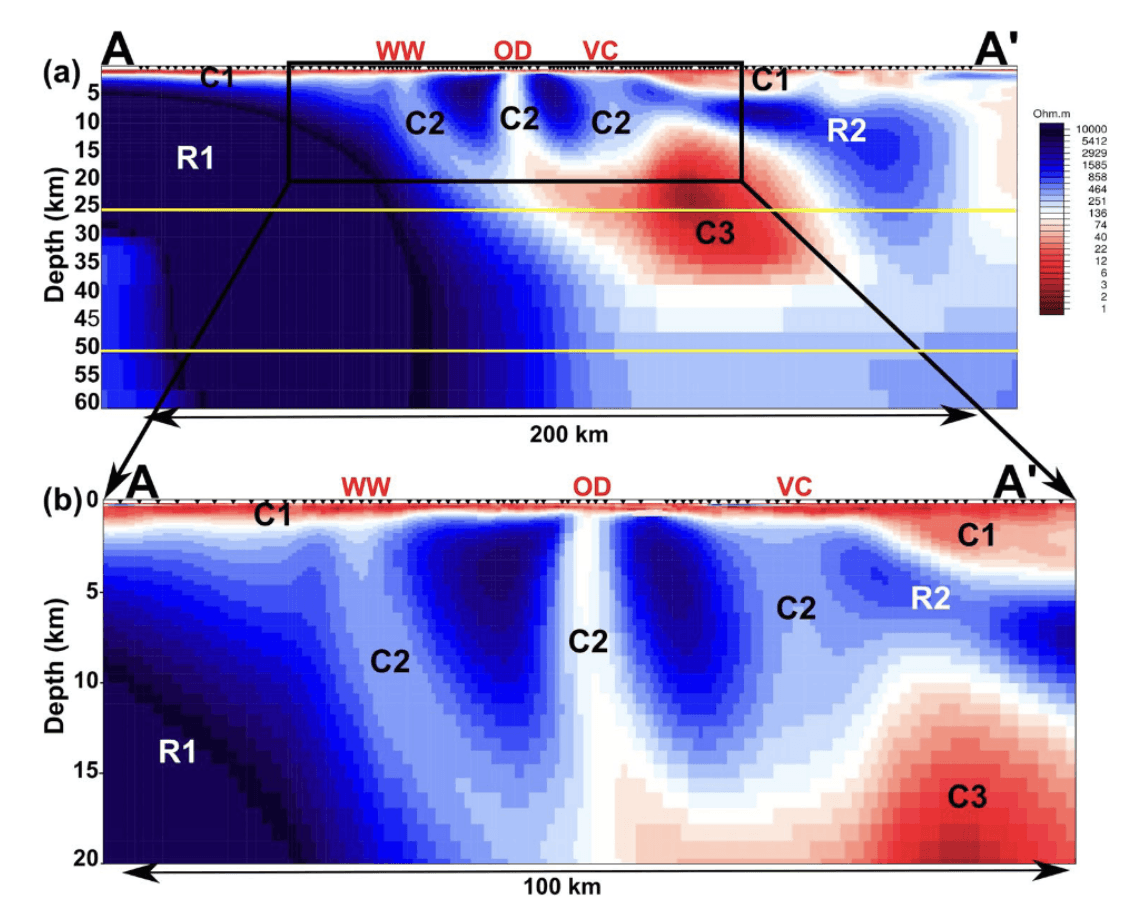
Results from the Lamont Grid are interpreted to be broadly analogous to a regional scale magnetotelluric profile across the Archean Gawler Craton (left-hand side) and Proterozoic mobile belt (right-hand side), Australia. The profile is characterized by very high resistivity (blue colour, R1 and R2) to a depth of more than 60 km. A striking high conductivity structure (C3) is situated at the margins of the Archean Gawler Craton at a depth 15–40 km. In addition, three narrow low-resistivity pathways (C2) extend from conductor C3 to the surface, which link the lower crust with major IOCG-U mineral deposits. Modified from Heinson et al., 2018)
(a) 2D resistivity model of Profile A-A’ to a depth of 60 km. (b) The central part of the profile is expanded to a depth of 20 km.
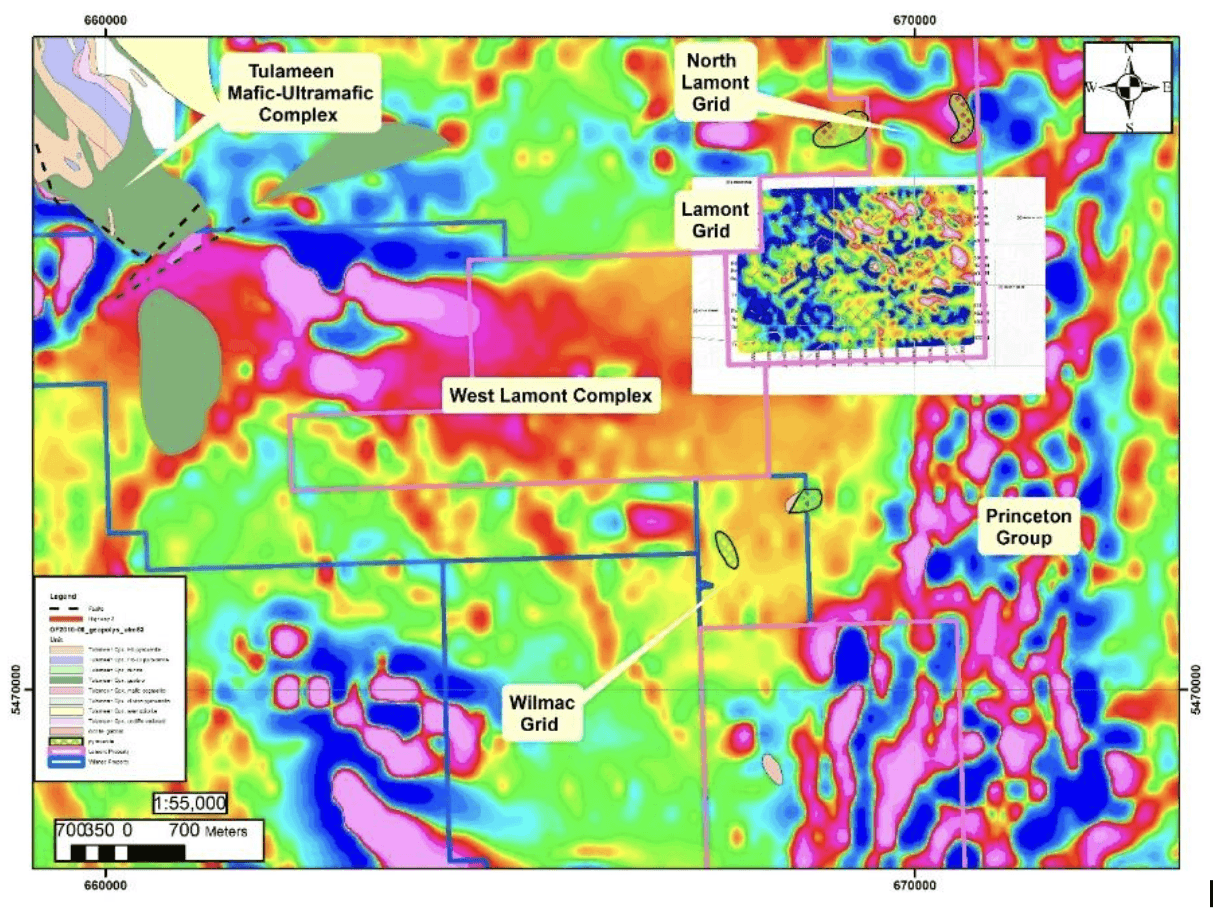
Results from the Lamont Grid are interpreted to document parent intrusives at depth, with branching “fingers” extending upward to, or near, surface, evident in both a resistivity high (to west) and a resistivity low (to east). The bodies are interpreted as two separate and distinct parent magmas, having differing geophysical signatures, one of which has intruded the other.
Results are further interpreted to document an intrusive complex comprising the eastern fringe of the West Lamont Complex.
Results from the Lamont Grid are interpreted to be broadly analogous to a regional scale magnetotelluric profile across the Archean Gawler Craton (left-hand side) and Proterozoic mobile belt (right-hand side), Australia. The profile is characterized by very high resistivity (blue colour, R1 and R2) to a depth of more than 60 km. A striking high conductivity structure (C3) is situated at the margins of the Archean Gawler Craton at a depth 15–40 km. In addition, three narrow low-resistivity pathways (C2) extend from conductor C3 to the surface, which link the lower crust with major IOCG-U mineral deposits. Modified from Heinson et al., 2018)
(a) 2D resistivity model of Profile A-A’ to a depth of 60 km. (b) The central part of the profile is expanded to a depth of 20 km.
Results from the Lamont Grid are interpreted to document parent intrusives at depth, with branching “fingers” extending upward to, or near, surface, evident in both a resistivity high (to west) and a resistivity low (to east). The bodies are interpreted as two separate and distinct parent magmas, having differing geophysical signatures, one of which has intruded the other.
Results are further interpreted to document an intrusive complex comprising the eastern fringe of the West Lamont Complex.
Results from the Lamont Grid are interpreted to be broadly analogous to a regional scale magnetotelluric profile across the Archean Gawler Craton (left-hand side) and Proterozoic mobile belt (right-hand side), Australia. The profile is characterized by very high resistivity (blue colour, R1 and R2) to a depth of more than 60 km. A striking high conductivity structure (C3) is situated at the margins of the Archean Gawler Craton at a depth 15–40 km. In addition, three narrow low-resistivity pathways (C2) extend from conductor C3 to the surface, which link the lower crust with major IOCG-U mineral deposits. Modified from Heinson et al., 2018)
(a) 2D resistivity model of Profile A-A’ to a depth of 60 km. (b) The central part of the profile is expanded to a depth of 20 km.
Results from the Lamont Grid are interpreted to document parent intrusives at depth, with branching “fingers” extending upward to, or near, surface, evident in both a resistivity high (to west) and a resistivity low (to east). The bodies are interpreted as two separate and distinct parent magmas, having differing geophysical signatures, one of which has intruded the other.
Results are further interpreted to document an intrusive complex comprising the eastern fringe of the West Lamont Complex.
Results from the Lamont Grid are interpreted to be broadly analogous to a regional scale magnetotelluric profile across the Archean Gawler Craton (left-hand side) and Proterozoic mobile belt (right-hand side), Australia. The profile is characterized by very high resistivity (blue colour, R1 and R2) to a depth of more than 60 km. A striking high conductivity structure (C3) is situated at the margins of the Archean Gawler Craton at a depth 15–40 km. In addition, three narrow low-resistivity pathways (C2) extend from conductor C3 to the surface, which link the lower crust with major IOCG-U mineral deposits. Modified from Heinson et al., 2018)
(a) 2D resistivity model of Profile A-A’ to a depth of 60 km. (b) The central part of the profile is expanded to a depth of 20 km.
Results from the Lamont Grid are interpreted to document parent intrusives at depth, with branching “fingers” extending upward to, or near, surface, evident in both a resistivity high (to west) and a resistivity low (to east). The bodies are interpreted as two separate and distinct parent magmas, having differing geophysical signatures, one of which has intruded the other.
Results are further interpreted to document an intrusive complex comprising the eastern fringe of the West Lamont Complex.
Industry Investment insights
Copper is the backbone of electrification and modern technology, with demand rising faster than supply — creating one of the decade’s strongest investment opportunities
5K
%
exponential increase in usage (1900–2020)
36M
t
Projected annual copper demand (McKinsey & Co)
6.5M
t
global supply shortfall expected
+5M
t
extra deficit from AI by 2030
Industry Investment insights
Copper is the backbone of electrification and modern technology, with demand rising faster than supply — creating one of the decade’s strongest investment opportunities
5K
%
exponential increase in usage (1900–2020)
36M
t
Projected annual copper demand (McKinsey & Co)
6.5M
t
global supply shortfall expected
+5M
t
extra deficit from AI by 2030
Industry Investment insights
Copper is the backbone of electrification and modern technology, with demand rising faster than supply — creating one of the decade’s strongest investment opportunities
5K
%
exponential increase in usage
(1900–2020)
36M
t
Projected annual copper demand
6.5M
t
global supply shortfall expected
+5M
t
extra deficit from AI by 2030
Industry Investment insights
Copper is the backbone of electrification and modern technology, with demand rising faster than supply — creating one of the decade’s strongest investment opportunities
5K
%
exponential increase in usage (1900–2020)
36M
t
Projected annual copper demand (McKinsey & Co)
6.5M
t
global supply shortfall expected
+5M
t
extra deficit from AI by 2030
503 - 905 West Pender Street
Vancouver, BC V6C 1L6 CA
info@rumbleresources.com
+1 604 377 8758
© 2025 Rumble Resources. All rights reserved.
503 - 905 West Pender Street
Vancouver, BC V6C 1L6 CA
info@rumbleresources.com
+1 604 377 8758
© 2025 Rumble Resources. All rights reserved.
503 - 905 West Pender Street
Vancouver, BC V6C 1L6 CA
info@rumbleresources.com
+1 604 377 8758
© 2025 Rumble Resources. All rights reserved.
503 - 905 West Pender Street
Vancouver, BC V6C 1L6 CA
info@rumbleresources.com
+1 604 377 8758
© 2025 Rumble Resources. All rights reserved.